
The Story
Welcome to The Sing Oil Blog! If you are new here, you may be wondering how you got here or what Sing Oil Company was. I may not be able to answer the first question, but I can definitely tell you all about Sing.
Sing Oil Company was a regional independent operator founded in Pelham, Georgia in 1935 by Mr. Lewis Hall Singletary. The company originally ran a "dealer station" model where Sing would purchase parcels of land across Georgia and the Carolinas to build gas stations for local managers, or dealers, to operate. Most stations consisted of a couple of pumps paired with a small office / service building sitting atop a gravel lot. "Save with Sing Quality Gas" was a common motto of the time, and Sing Oil often advertised its fuel as being 2¢ cheaper per gallon when compared to the national competitors.
Things began to change during the mid-1960's when L.H.'s son, Richard "Dick" Singletary assumed control of the company. Dick moved the corporate offices from Pelham to nearby Thomasville, Georgia, and led the oil company as it entered a new vertical: convenience stores.
 |
| Tallahassee Sing #3 |
The first "Sing Stores" opened in Columbus & LaGrange, Georgia, along with Tallahassee, Florida, between 1965 and 1968. Sing was one of the first companies in the Southeast to replicate the model pioneered a decade earlier by 7-Eleven and open small convenience stores carrying a variety of staple food items.
Sing Stores became wildly popular in the 1970's across Georgia and North Florida, with expansion efforts focused on residential neighborhoods in Atlanta, Columbus, LaGrange, and Tallahassee. These new locations with self-service pump islands slowly began to replace the smaller dealer stations Sing was originally known for.
During the 1980's, the expansion continued into Alabama, Mississippi, and Louisiana, while the convenience stores evolved from the neighborhood spot to grab a head of lettuce into more of what we know them as today. The snack food craze was on the rise, as was the concept that c-stores could sell hot food to weary drivers. Sing added delicatessens to many of its stores, which proved to be a hit.
On the other hand, Sing was never afraid to test new concepts with its convenience stores, despite most of them becoming "lessons learned." From a fast food mall to a hardware store to a discount grocery store to a mobile home factory, Sing tried it all.
In the end, Sing Oil Company announced it would sell to Amoco in 1990, ending its 55-years in Southwest Georgia; it owned or operated fifty-six stations in five states at the time. According to a 1990 article in the Tallahassee Democrat, Sing sold more than 60 million gallons of petroleum products resulting in annual sales of $30 million. Sing's final market of operation was in Tallahassee, where all former stations were sold to Circle K in 1999 as a condition of the then-recent BP-Amoco merger.
As for me, I started this site in 2021 to serve as a central place to document the history of these long-forgotten convenience stores. Years before, I was given a disorganized box of old photographs which I set forth the goal to categorize and identify. The Sing Oil Blog has proved pivotal to that project by providing a space to organize my many thoughts on each station. Moreover, it has afforded me the opportunity to share insight into the operations of the company and learn new stories from people who have found the site. I always welcome readers to reach out to me if they have stories to tell or pictures to share.

Furthermore, I have also expanded my coverage to include chronicles of supermarkets across the Southeast. Much like how a Sing Store helps to tell the story of a neighborhood, a supermarket often brings a community together and provides a rich perspective of life in the area. Other retailer history sites, such as Albertsons Florida Blog or Mid-South Retail served as the inspiration for me embarking in this effort. Likewise, I realized there is a broader audience for this content, therefore, leading to a wider reach. These supermarket chains often, in the end, exhibit macro examples of the successes and failures Sing Oil Co. endured over its tenure. History does not occur in a vacuum, and the broader context leading to many of these strategic business decisions is fascinating to explore. I hope that you enjoy this forensic journalism as much as I do and remember that it is hard to study the past if nobody is there to document the present. Make sure to check back often for new explorations and perspectives.
Until then,
- The Sing Oil Blogger

Locations
Throughout its history developing convenience stores, Sing Oil Company utilized several styles of station architecture. The list below categorizes the various designs of Sing Stores while also providing a directory of posts covering each location.
1960s Stop N' Shop

This was Sing's first convenience store - gas station combo design and was implemented in the second half of the 1960's. Only a few of these stores were built before the similar '70s style was adopted, and all were subsequently updated to match the exterior of the 1970's format. When constructed, the convenience store featured a backlit awning and no columns out front. These stores also had a sconce mounted to the brick walls on either side of the front glazing.
1960s Stop N' Shop with Brick Columns

As a derivation of the Stop N' Shop model, this format featured a similar interior to the earlier stores but upgraded the exterior to have a shingled awning supported by columns. These stores would have still utilized the Stop N' Shop branding on exterior signage. In contrast to the later stores, these are differentiated by one brick column on each corner of awning, in contrast to the wood ones in the center.
- 1965 | Columbus #3 | Shopping Plaza
- 1968 | Tallahassee #3
- 1969 | Tallahassee #4 | Deli | Shopping Plaza
- 1972 | Winters Chapel^
1970s Rectangle
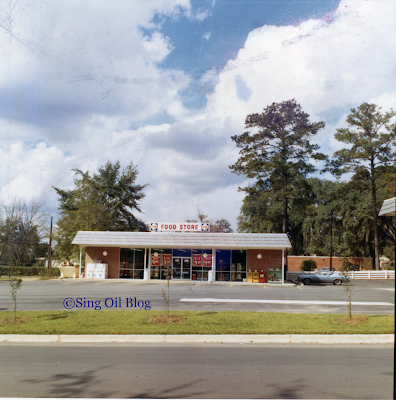
Sing's most common store design, this format further iterated the Stop N' Shop model to include a shingled awning over the front of the store supported by wood columns. The interior of these stores would have closely resembled the previous store designs. Sing would begin to modify this model in the late 1970's, when it also began to experiment with a new convenience store format. These stores were typically 2,800-3,000 sq ft when built.
With Front Columns:- 1969 | LaGrange #2 | Deli
1969 | Tallahassee #5 (Food Store Only)^- 197x | Thomaston
- 1970 | Columbus #4 | Deli
- 1970 | Perry #1 | Deli
- 1970 | Rockbridge (Shop on Right)
- 1971 | Columbus #5
- 1971 | Thomasville #5
- 1972 | Tallahassee #7 | Deli (Expanded)
- 1972 | Knoxville #1^
1972 | Knoxville #2^- 1973 | Memorial Drive (Shop on Right)
- 1973 | Six Flags
197x | Redan- 1975 | Tallahassee #8 | Sing Fast Food Mall
- 1975 | Tallahassee #9
- 1975 | Jacksonville #1^
- 1975 | Jacksonville #2 (Food Store Only)^
1976? | Powder Springs (Brick Columns) (1972-1976)1977 | Tallahassee #10 | True Value | Deli (Expanded)- 1977 | Columbus #6
- 1978 | Carrollton | Laundry
Small Format Square

The small format square stations were Sing's first attempt at a unique station design in over 10 years. Typically located on the corner of an intersection, these stores had two entrances and were often aligned with one door facing each road. The stores originally had the cash registered centered between the two doors and a gas payment window directly behind it. Drink coolers lined one of the rear walls of the store and a counter with the soft drink fountain flanked the other. None of these stores were built with delicatessens, but several were retrofitted to add hot food. This station format was used for about six years, until it was replaced by its larger cousin below. These stores were approximately 2,800 sq ft when built.
1977 | Sandy Plains*- 1978 | Albany #7 | Deli
- 1978 | Albany #8
- 1979 | Columbus #7
- 1979 | Columbus #8
1979 | Trickum (Shop on Right, Self-Carwash Behind)- 1979 | Jackson #2 | Deli
- 1980 | Port St. Joe | Deli
- 1981 | Jackson #3 | Deli
- 1983 | LaGrange #4
Large Format Square

The large format square stores are a modified, expanded version of the late '70s square model. These stations combined the two entrances into one that was centrally located between the two façades. To the left of the door was the gasoline payment window, directly behind which was the cashier stand. Adjacent to the cashier was the deli, which I believe was included in all implementations of these stores. The aisles were aligned perpendicular to the door and drink coolers lined the entire back wall. A small seating area was stationed to the left of the entrance, with the restrooms behind. These stores were approximately 3,600 sq ft when built.
With Cashier Transom Window Bank:
- 1984 | Jackson #4 | Deli
- 1984 | Jackson #5 | Deli
- 1984 | Bradfordville | Deli
- 1984 | Jacksonville #3 | Deli
- 1986 | Moultrie | Deli^
Without Cashier Transom Window Bank:
- 1985 | Laurel | Deli*
- 1985 | Columbia | Deli
- 1985 | Opp^
- 1986 | Enterprise^
- 1986 | Troy^
- 1986 | Tallahassee #12 | Deli
1980s Rectangle

|
| Google Street View - Bogalusa, LA - May 2014 |
Although this was Sing's last station prototype used before the Amoco merger, it is also the one I have the least historical information on. I have not found a single historical picture of one of these station and do not know exactly how they would have looked back in the 1980's. I was lucky enough to find this street view from Bogalusa which shows Sing's 1980's awning (painted red); unfortunately, sheet metal now covers Sing's shingles at this store. These stores were approximately 3,000 - 3,200 sq ft when built and likely would have all included a deli. I have been in two of these stores, and I believe they originally had the cashier counter directly in front of the door, with snacks and drink coolers on the right side of the store and a deli seating area / fountain drink section to the left. Some of the later models of this store include a window on the left side of the building for the seating area.
Without Left Window:
1985 | Tallahassee #11 | Deli- 1985 | Tallahassee #13 | Deli
- 198x | Bogalusa | Deli
With Left Window:
- 1987 | LaGrange #5 | Deli
- 1987 | Tallahassee #14 | Deli
- 1989 | Jacksonville #4 | Deli
- 1994 | "Columbus #9"
Miscellaneous

These stores don't quite fit the bill of the categories above, and seem to be one-off iterations for a variety of reasons. In the case of the Perry Travel Center, this store likely would have seen more clones had Sing not merged with Amoco the next year
- 1965 | Thomasville #2 | Dealer Station
- 1971 | Tallahassee #6 | Deli | Sing Sportswear | Sing District Office (Large Format, Spanish Revival)
197x | Jackson #1(Convenience Store under Canopy, built before 1979)1972 | Chamblee-Dunwoody (C-store only)- 1979 | Gadsden
- 1983 | Thomasville #6 | The Happy Penny (Convenience Store under Canopy)
- 1988 | Gulfport | Deli (Larger Version of Thomasville #6)
- 1989 | Perry #2 | Deli (Travel Center)
Unaffiliated, Post Merger

|
| Google Street View - Tallahassee, FL - April 2011 |
These stores are a rare breed: Sing branded Amoco convenience stores. I have found licensing information that leads me to believe more of these were out there but I couldn't find enough proof to include them here. These stores only appeared in the Tallahassee market during the 1990's and were wiped away by 1999. I really wish I had pictures of these! The most interesting example is Amoco-Sing #5059, shown above, which was a combination McDonald's / convenience store.
Planned, Undeveloped Sites
Although Sing Oil Company had slowed down their expansion efforts during the time leading up to the Amoco merger, they had still purchased parcels of land to develop future convenience stores. The following locations were sold to Amoco as undeveloped or partially developed locations.
- St John's County, FL - Vacant lot
- Hanging Moss, Jackson, MS - Marathon station
- Holder, FL - Unknown
- Killearn, Tallahassee, FL
- Columbus #9 - 1980s Rectangle Sing building, Hop-In / Shell station
- Columbus #10 - Circle K station
- Woodville, FL - Circle K station
- Tallahassee #15 (Tharpe St) - Bruster's Ice Cream
- Bradfordville, FL - Land surrounding station
Missing / No Information
Due to Sing's numbering system, I was able to identify the following station that I know existed but I have no information on. I would love to locate it, one day.
- 1969-1982 | LaGrange #3 (Possibly New Franklin Road)
Key:
* denotes an imprecise opening year
^ denotes a station sold prior to the Amoco merger
" denotes a station built after the Amoco merger using Sing plans
Italicized Deli indicates the department opened prior to September 1985
Map
In addition to the directory above, this map provides a visual guide Sing's locations throughout the Southeast. Click on each station icon for more information and helpful links.


